

Click the image to read the PDF
Click the button to download the PDF
Offshore Commentary
Market Overview:
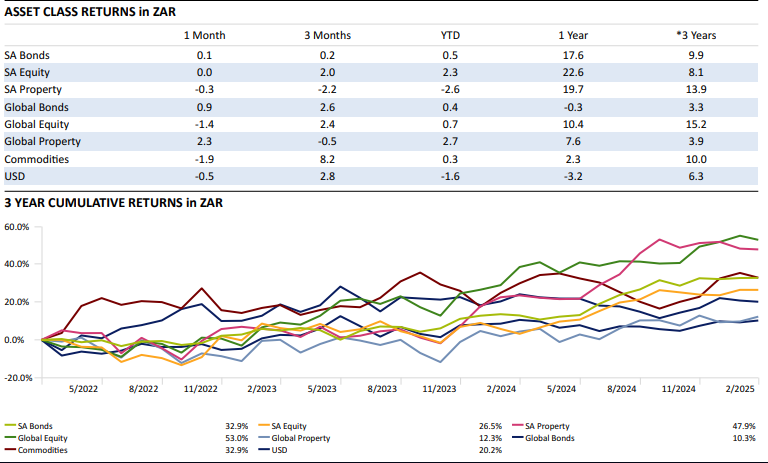
February was marked by geopolitical uncertainty and shifting policy landscapes, both globally and domestically. South African markets navigated a challenging environment, with equities ending the month flat and bonds experiencing a mixed performance. Global market sentiment was dampened by U.S. economic and foreign policy uncertainty, leading to declines in U.S. equity indices, while South African investors remained focused on inflation, fiscal policy, and monetary dynamics.
The underperformance of U.S. equities (-1.3% S&P 500, -3.9% Nasdaq) weighed on global risk sentiment, while emerging markets outperformed slightly (+0.5% MSCI EM). European equities saw a resurgence, particularly in financials, benefiting from capital inflows and attractive valuations. U.S. Treasury yields fell (-33bps for the 10-year), reflecting concerns over economic growth rather than inflation, a shift that could influence South African monetary policy considerations. The dollar lost some ground, which provided mild relief to emerging market currencies, including the rand.
South African Asset Class Performance:
- Equities: The FTSE/JSE All Share Index ended the month unchanged, underperforming emerging market peers. Key stock movements included strong gains for Prosus (+11.6%) and Naspers (+12.3%), while the resources sector (-6.2%) weighed on the broader index following a stellar January performance (+17.9%). Financials were mixed, with banks (-1.1%) under pressure amid policy uncertainty.
- Bonds: South African bond yields rose for the third consecutive month, reflecting ongoing fiscal concerns and market scepticism regarding government reforms. Inflation-linked bonds (ILBs) outperformed (+1.0%) on seasonal inflation carry and heightened inflation expectations due to VAT hikes.
- Property: The listed property sector extended its year-to-date decline (-2.6%), despite strong gains for Growthpoint (+6.1%), Fairvest (+4.4%), and MAS (+2.4%). NEPI Rockcastle (-4.7%) underperformed due to weak forward guidance.
- Currency: The rand was relatively stable against the U.S. dollar (-0.2%), aided by a weaker dollar and moderate inflation expectations.
Economic Performance & Policy Developments:
- South African inflation rose to 3.2% (from 3.0% in December), aligning with forecasts. The increase was primarily due to base effects in fuel prices, which have seen consecutive monthly increases. Food inflation remains subdued (1.5%).
- Despite rising inflation, real interest rates remain positive, keeping the door open for SARB to cut rates further. Market pricing suggests a 75% probability of a 25bps rate cut in 1H25, with further easing expected later in the year, assuming stable global conditions.
- The postponement of the national budget created short-term uncertainty, particularly for bond investors. The delayed VAT increase proposal (2%) stirred inflation concerns but is unlikely to materialize in its current form. The key fiscal challenges remain economic stagnation, inefficient government spending, and a strained tax base.
- Q4 2024 data pointed to a modest economic recovery driven by agricultural sector normalization. However, leading indicators, including PMI and the SARB composite index, suggest continued economic softness. The Q4 GDP release is expected to fall below the revised consensus forecast of 0.9% q/q.
Key Risks & Opportunities:
- After a period of stability, power cuts returned in February, though Eskom and the government assured investors of continued progress in energy security. The near-term energy outlook remains vulnerable.
- South Africa’s position on international matters, including the Expropriation Act and the ICC case against Israel, drew scrutiny from the U.S., potentially impacting trade relations. However, European leaders reaffirmed their partnership with SA at the G20 foreign ministers’ meeting.
- Encouragingly, South Africa improved its compliance rating on four of the six remaining Financial Action Task Force (FATF) action items. If the final two are addressed, SA could be removed from the grey list by October 2025, a development that would boost investor confidence.
