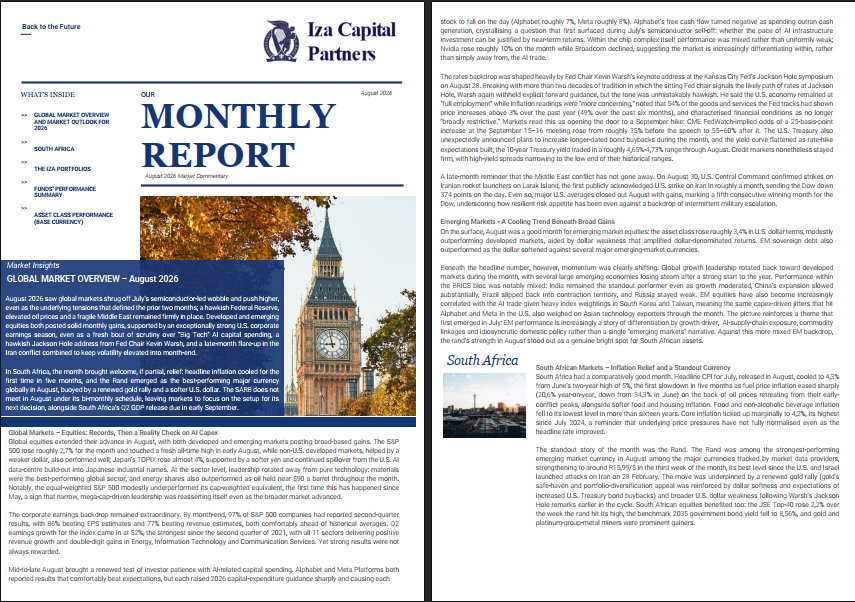
Our report is available below
Click the image to view/download the PDF
Market Insights
 August 2026 saw global markets shrug off July’s semiconductor-led wobble and push higher, even as the underlying tensions that defined the prior two months; a hawkish Federal Reserve, elevated oil prices and a fragile Middle East remained firmly in place. Developed and emerging equities both posted solid monthly gains, supported by an exceptionally strong U.S. corporate earnings season, even as a fresh bout of scrutiny over “Big Tech” AI capital spending, a hawkish Jackson Hole address from Fed Chair Kevin Warsh, and a late-month flare-up in the Iran conflict combined to keep volatility elevated into month-end.
Global Markets – Equities: Records, Then a Reality Check on AI Capex
Global equities extended their advance in August, with both developed and emerging markets posting broad-based gains. The S&P 500 rose roughly 2,7% for the month and touched a fresh all-time high in early August, while non-U.S. developed markets, helped by a weaker dollar, also performed well; Japan’s TOPIX rose almost 4%, supported by a softer yen and continued spillover from the U.S. AI data-centre build-out into Japanese industrial names. At the sector level, leadership rotated away from pure technology: materials were the best-performing global sector, and energy shares also outperformed as oil held near $90 a barrel throughout the month. Notably, the equal-weighted S&P 500 modestly underperformed its cap-weighted equivalent, the first time this has happened since May, a sign that narrow, mega-cap-driven leadership was reasserting itself even as the broader market advanced.
The corporate earnings backdrop remained extraordinary. By month-end, 97% of S&P 500 companies had reported second-quarter results, with 86% beating EPS estimates and 77% beating revenue estimates, both comfortably ahead of historical averages. Q2 earnings growth for the index came in at 52%, the strongest since the second quarter of 2021, with all 11 sectors delivering positive revenue growth and double-digit gains in Energy, Information Technology and Communication Services. Yet strong results were not always rewarded.
Mid-to-late August brought a renewed test of investor patience with AI-related capital spending. Alphabet and Meta Platforms both reported results that comfortably beat expectations, but each raised 2026 capital-expenditure guidance sharply and causing each stock to fall on the day (Alphabet roughly 7%, Meta roughly 8%). Alphabet’s free cash flow turned negative as spending outran cash generation, crystallising a question that first surfaced during July’s semiconductor sell-off: whether the pace of AI infrastructure investment can be justified by near-term returns. Within the chip complex itself performance was mixed rather than uniformly weak; Nvidia rose roughly 10% on the month while Broadcom declined, suggesting the market is increasingly differentiating within, rather than simply away from, the AI trade.
The rates backdrop was shaped heavily by Fed Chair Kevin Warsh’s keynote address at the Kansas City Fed’s Jackson Hole symposium on August 28. Breaking with more than two decades of tradition in which the sitting Fed chair signals the likely path of rates at Jackson Hole, Warsh again withheld explicit forward guidance, but the tone was unmistakably hawkish. He said the U.S. economy remained at “full employment” while inflation readings were “more concerning,” noted that 54% of the goods and services the Fed tracks had shown price increases above 3% over the past year (49% over the past six months), and characterised financial conditions as no longer “broadly restrictive”. Markets read this as opening the door to a September hike: CME FedWatch-implied odds of a 25-basis-point increase at the September 15-16 meeting rose from roughly 35% before the speech to 55-60% after it. The U.S. Treasury also unexpectedly announced plans to increase longer-dated bond buybacks during the month, and the yield curve flattened as rate-hike expectations built; the 10-year Treasury yield traded in a roughly 4,65%-4,73% range through August. Credit markets nonetheless stayed firm, with high-yield spreads narrowing to the low end of their historical ranges.
A late-month reminder that the Middle East conflict has not gone away. On August 30, U.S. Central Command confirmed strikes on Iranian rocket launchers on Larak Island, the first publicly acknowledged U.S. strike on Iran in roughly a month, sending the Dow down 374 points on the day. Even so, major U.S. averages closed out August with gains, marking a fifth consecutive winning month for the Dow, underscoring how resilient risk appetite has been even against a backdrop of intermittent military escalation.
Emerging Markets – A Cooling Trend Beneath Broad Gains
On the surface, August was a good month for emerging market equities: the asset class rose roughly 3,4% in U.S. dollar terms, modestly outperforming developed markets, aided by dollar weakness that amplified dollar-denominated returns. EM sovereign debt also outperformed as the dollar softened against several major emerging-market currencies.
Beneath the headline number, however, momentum was clearly shifting. Global growth leadership rotated back toward developed markets during the month, with several large emerging economies losing steam after a strong start to the year. Performance within the BRICS bloc was notably mixed: India remained the standout performer even as growth moderated, China’s expansion slowed substantially, Brazil slipped back into contraction territory, and Russia stayed weak. EM equities have also become increasingly correlated with the AI trade given heavy index weightings in South Korea and Taiwan, meaning the same capex-driven jitters that hit Alphabet and Meta in the U.S. also weighed on Asian technology exporters through the month. The picture reinforces a theme that first emerged in July. EM performance is increasingly a story of differentiation by growth driver, AI-supply-chain exposure, commodity linkages and idiosyncratic domestic policy rather than a single “emerging markets” narrative. Against this more mixed EM backdrop, the rand’s strength in August stood out as a genuine bright spot for South African assets.
South Africa

South African Markets – Inflation Relief and a Standout Currency
South Africa had a comparatively good month. Headline CPI for July, released in August, cooled to 4,3% from June’s two-year high of 5%, the first slowdown in five months as fuel price inflation eased sharply (20,6% year-on-year, down from 34,3% in June) on the back of oil prices retreating from their early-conflict peaks, alongside softer food and housing inflation. Food and non-alcoholic beverage inflation fell to its lowest level in more than sixteen years. Core inflation ticked up marginally to 4,2%, its highest since July 2024, a reminder that underlying price pressures have not fully normalised even as the headline rate improved.
The standout story of the month was the Rand. The Rand was among the strongest-performing emerging market currency in August among the major currencies tracked by market data providers, strengthening to around R15,99/$ in the third week of the month, its best level since the U.S. and Israel launched attacks on Iran on 28 February. The move was underpinned by a renewed gold rally (gold’s safe-haven and portfolio-diversification appeal was reinforced by dollar softness and expectations of increased U.S. Treasury bond buybacks) and broader U.S. dollar weakness following Warsh’s Jackson Hole remarks earlier in the cycle. South African equities benefited too: the JSE Top-40 rose 2,2% over the week the rand hit its high, the benchmark 2035 government bond yield fell to 8,56%, and gold and platinum-group-metal miners were prominent gainers.
Special Themes and Policy Watch
Jackson Hole Breaks With Tradition, Not With Hawkishness
For the first time in over two decades, the sitting Fed chair used the Jackson Hole keynote to withhold an explicit signal on the path of rates, but Warsh’s underlying message was unambiguously hawkish, and markets responded by materially raising the odds of a September hike. The Fed’s communication style has changed under Warsh; its underlying reaction function, focused squarely on inflation, has not.
The AI Trade’s Reckoning Moves From Chips to Capex
July’s story was a semiconductor valuation correction; August’s was a capex reckoning at the hyperscaler level. Alphabet and Meta’s post-earnings declines, despite beating estimates, show the market’s scrutiny of the AI investment cycle broadening beyond chipmakers to the companies funding the build-out with free-cash-flow trajectories now under as much scrutiny as revenue growth.
Middle East: Elevated but Range-Bound, Not Resolved
Unlike the sharp spikes and reversals of June and July, Oil traded largely in the upper-$80s during the latter half of August, suggesting markets were pricing a persistent geopolitical risk premium rather than either full resolution or a renewed supply shock. The month-end strikes on Iranian territory were a reminder that this equilibrium remains fragile.
Gold and the Rand: A Rare Emerging-Market Bright Spot
The Rand and South Africa’s gold-linked equities stood out during August. A combination of rising precious-metal prices and a softer U.S. dollar supported the currency and resource sector, highlighting the extent to which South African asset performance remains influenced by the gold cycle and global dollar dynamics as much as by domestic fundamentals.
South African Inflation Turns a Corner, Cautiously
The first deceleration in headline CPI in five months offers the SARB some room to manoeuvre, but a rising core inflation print means the case for caution, and for the four-two hold to potentially shift in September has not disappeared.
Closing Remarks
August 2026 showed a market able to climb a wall of worry: record highs for U.S. equities, a strong earnings season, and a rare weak-dollar tailwind for emerging markets and the Rand all coexisted with a hawkish pivot from the Federal Reserve, renewed doubts about AI capital spending discipline, and a still-unresolved Middle East conflict. For South Africa specifically, cooling inflation and a standout currency performance provided genuine relief after a difficult two months, even as the underlying drivers, global gold prices and dollar weakness, sit largely outside domestic control. For investors more broadly, the message from August is consistent with June and July: this remains a market where headline index gains can mask meaningful dispersion underneath, and where diversification, quality, and attention to capital discipline continue to matter more than broad exposure to any single theme.
The Iza Portfolios
Iza Global Balanced Fund
The Iza Global Balanced Fund delivered a strong return of 2,41% (GBP) and 2,91% (USD) during August, bringing its year-to-date return to 9,67% (GBP) and 10,27% (USD). The Fund outperformed its peer benchmark during the month in both currencies (benchmark returns of 1,83% (GBP) and 2,28% (USD)) and extended its outperformance on a year-to-date basis (benchmark returns of 6,95% (GBP) and 6,71% (USD)). Longer-term performance also remained solidly ahead of benchmark, with Fund returns of 15,71% (GBP) and 16,09% (USD) over one year (versus benchmark returns of 12,11% (GBP) and 12,16% (USD)) and 21,68% (GBP) and 25,61% (USD) over two years (versus benchmark returns of 18,81% (GBP) and 21,16% (USD)).
August marked a decisive rebound for the Fund following July’s weakness, with broad-based gains across equities, alternative assets and structured products. The strongest performing underlying holdings during the month were gold, delivering a positive return of 9,39% as precious metals rallied sharply, the Santander Note (NKY/SX5E/MXEF), delivering a return of 6,94%, and the Artemis SmartGARP Global Equity Fund, delivering a return of 4,44%. There were no material detractors during the month.
In August, our top contributions to performance came from the iShares MSCI World USD allocation, which contributed 0,67%, Jupiter World Equity Fund, which contributed 0,37%, and gold, which contributed 0,30% following its strong rally over the month. Given the broad-based nature of the gains, detractors had only a marginal impact on overall performance.
In summary, the Fund rose by 2,41% (GBP) and 2,91% (USD) in August, recovering strongly from July’s pullback as gains in gold, global equities and structured note exposures broadened across the portfolio. The Fund’s year-to-date return now stands at 9,67% (GBP) and 10,27% (USD), comfortably ahead of its benchmarks at 6,95% (GBP) and 6,71% (USD), and the Fund continues to outperform over the one- and two-year periods as well. Overall, August represented a return to form for the Fund, with the diversified allocation across equities, gold, alternative strategies and structured products all contributing positively, while detractors remained isolated and immaterial to overall performance. The portfolio continues to maintain a balanced approach, combining growth opportunities with diversification through alternative investments, structured products, money market exposure and cash holdings.
Iza Global Equity Fund
The Iza Global Equity Fund delivered a strong return of 2,99% (GBP) and 3,51% (USD) during August, bringing its year-to-date return to 11,79% (GBP) and 12,42% (USD). The Fund outperformed its benchmark, the MSCI ACWI Index, during the month in both currencies (benchmark returns of 1,91% (GBP) and 2,67% (USD)), though it remains behind on a year-to-date basis (benchmark returns of 12,59% (GBP) and 13,52% (USD)). The Fund has also lagged the benchmark over the one and two year period, with Fund returns of 18,20% (GBP) and 18,61% (USD) over one year (versus benchmark returns of 21,92% (GBP) and 22,35% (USD)) and 24,70% (GBP) and 28,72% (USD) over two years (versus benchmark returns of 37,33% (GBP) and 41,67% (USD)).
August delivered broad-based gains across the Fund’s underlying managers, marking a strong rebound following July’s weakness. The strongest performing underlying holdings during the month were Ranmore Global Equity, delivering a positive return of 6,85%, the iShares MSCI World USD allocation, delivering a return of 3,58%, and Jupiter World Equity Fund, delivering a return of 3,39%. There were no material detractors during the month, with every underlying holding posting a flat or positive return; Guinness Global Innovation was the only notable laggard, though it still delivered a positive return of 3,58% relative to its peers.
In August, our top contributions to performance came from the iShares MSCI World USD allocation, which contributed 0,65%, Jupiter World Equity Fund, which contributed 0,49%, and Northstar Global Equity, which contributed 0,42%. With gains broad-based across the portfolio, there were no meaningful detractors to overall contribution during the month.
In summary, the Fund rose by 2,99% (GBP) and 3,51% (USD) in August, recovering strongly from July’s weakness as gains broadened across virtually all underlying managers, led by Ranmore Global Equity, the iShares MSCI World allocation and Jupiter World Equity. The Fund’s year-to-date return now stands at 11,79% (GBP) and 12,42% (USD), though it continues to trail its benchmark, which returned 12,59% (GBP) and 13,52% (USD) over the same period, as well as over the one- and two-year periods. Overall, August was a positive month across the board for the Fund’s underlying strategies, though the Fund’s continued lag versus the MSCI ACWI benchmark highlights the ongoing headwind from its relative underweight to the strongest-performing areas of the broader index. The portfolio continues to maintain a multi-manager approach designed to deliver long-term outperformance of the MSCI ACWI Index, while managing short-term volatility through manager diversification.
Quote for the month
Be fearful when others are greedy, and greedy when others are fearful.
Warren Buffett
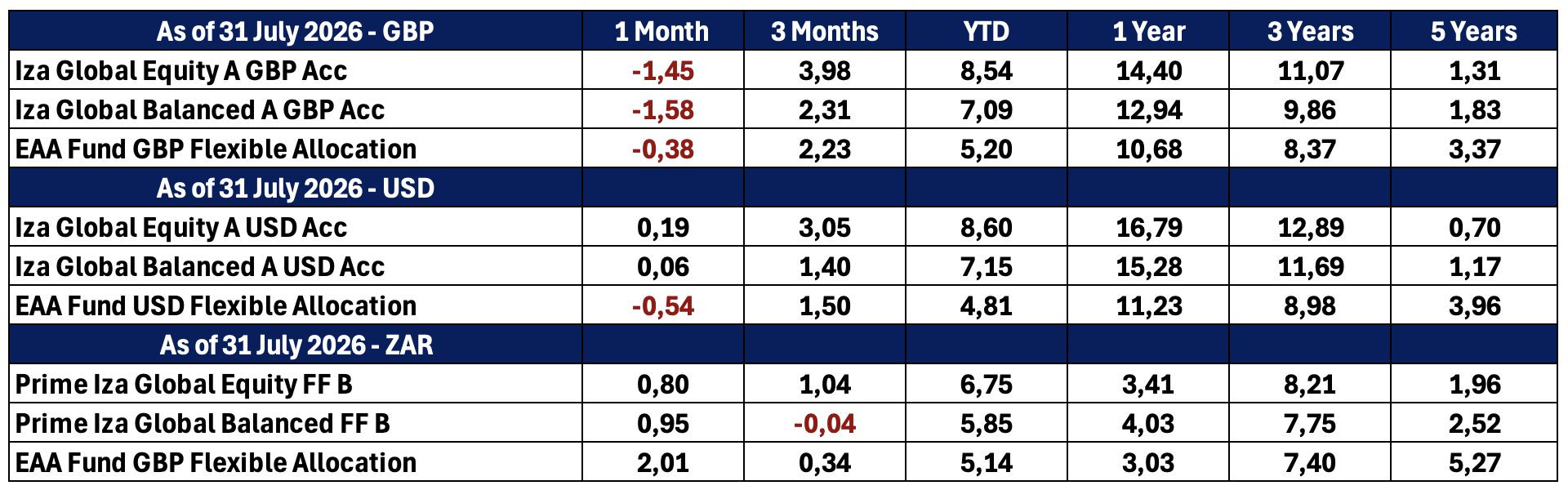
Funds’ Performance Summary
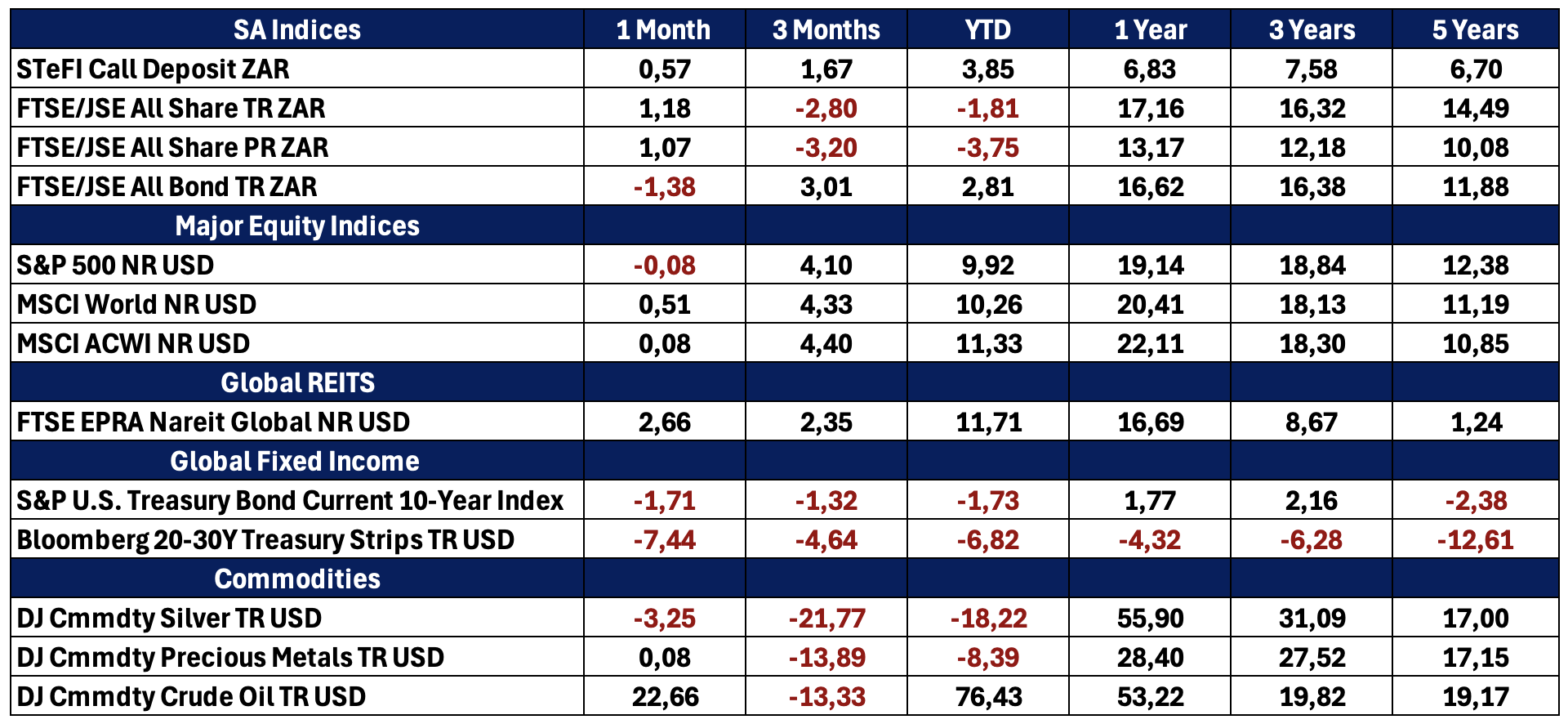
Asset Class Performance (Base Currency)